
10 Facebook E-commerce Apps That Help You Sell on Facebook and Instagram

Facebook ecommerce apps in this guide let you:
- Integrate your product catalog with Meta’s Commerce Manager, so it appears in Facebook Shops and Instagram Shopping,
- Keep your inventory and pricing up to date,
- Tag products in posts, Stories, and Reels,
- Track your ad performance with the Meta Pixel or Conversion API.
I’ve organized the tools by context and use case. It includes solutions for sellers who:
- Don’t yet have an online store,
- Use the mainstream e-commerce platforms (Shopify, WooCommerce, etc.),
- Need finer control over their product feed and ad creative,
- Want to track ad performance,
- Manage large catalogs or multiple sales channels at once.
Facebook E-commerce Apps: Quick Comparison
Before we dive in, here’s a quick overview of the 10 Facebook and Instagram e-commerce apps.
Prices and ratings current as of June 2026.
The 10 Best Facebook E-commerce Apps for Selling on Facebook and Instagram
Before we dive into the apps, here’s how I qualified them for this list:
- Real connection to Meta. Every app here connects your store to Facebook and Instagram Shops or Commerce Manager and syncs your product catalog.
- Use-case fit. Each pick is the right answer for a specific pain point.
- Ratings, features & pricing. I weighed Shopify App Store, WordPress.org, G2, and Capterra ratings alongside actual capability and pricing transparency.
- Currency. Every tool on this list is active, recently updated, compatible with Meta’s current commerce setup, and has verified pricing.
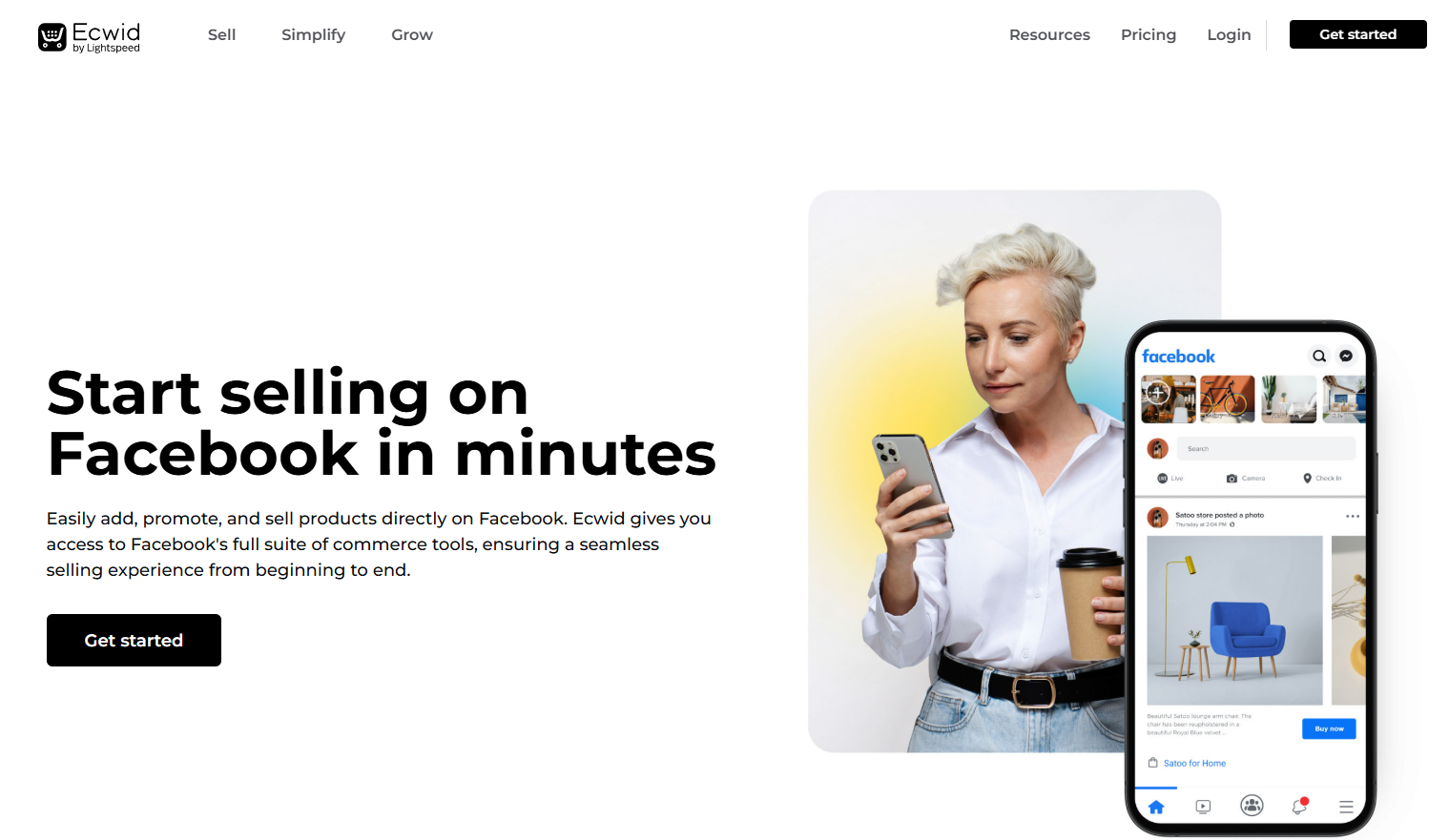
1. Ecwid by Lightspeed: best for selling without an online store
Ecwid is an embeddable store that attaches to any existing website, social profile, or Facebook Page. It also runs as a standalone storefront with no website required.
Best for: Small businesses, first-time sellers, and entrepreneurs without an existing website who want to start selling on Facebook and Instagram without committing to a full ecommerce platform first.
Key features & benefits
- Native Facebook and Instagram catalog sync included, no additional app needed.
- Beginner-friendly setup; no development background needed.
Areas for improvement & limitations
- Selling on Facebook and Instagram requires the Venture tier ($29/mo billed annually).
- Reviewers note that prices have risen, and cancellation terms have tightened since the Lightspeed acquisition.
Pricing (June 2026): Venture $29/mo, Business $49/mo, Unlimited $119/mo when billed annually.
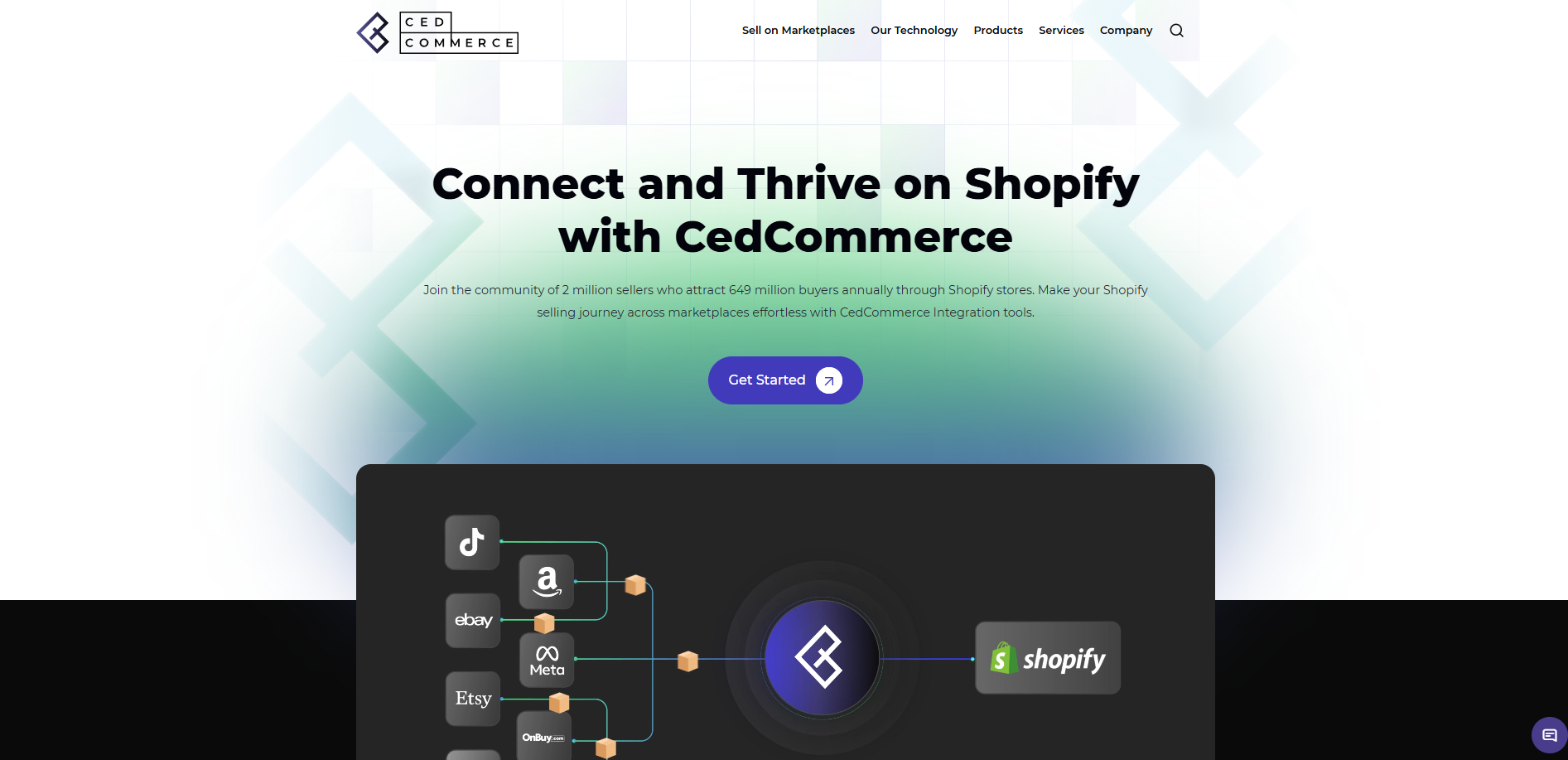
2. CedCommerce: best all-in-one app for Shopify stores
CedCommerce’s Facebook Feed Sync and Pixel app is a higher-rated alternative to Shopify’s official Meta integration. It combines real-time catalog sync, Meta Pixel and Conversion API setup, and Facebook ad campaign management.
Best for: Shopify sellers who want catalog sync, ad tracking, and campaign management from one tool instead of patching together the official Meta app with workarounds.
Key features & benefits
- Real-time product and inventory sync to Facebook and Instagram.
- One-click setup enables Meta Pixel and Conversion API tracking (no-code).
- Facebook ad campaign management from inside the Shopify dashboard.
- Multichannel support (Amazon, Etsy, eBay, Walmart, TikTok, and more) if you choose to expand beyond Meta.
Areas for improvement & limitations
- Conversion API tracking is gated to the Growth plan; the free tier covers only 100 stock-keeping units (SKUs) and one basic ad campaign.
Pricing (June 2026): Basic: free (up to 100 SKUs, one ad campaign). Growth: $13/mo (up to 10,000 SKUs, Conversion API, 10 campaigns). Accelerate: $99/mo (unlimited SKUs and campaigns).
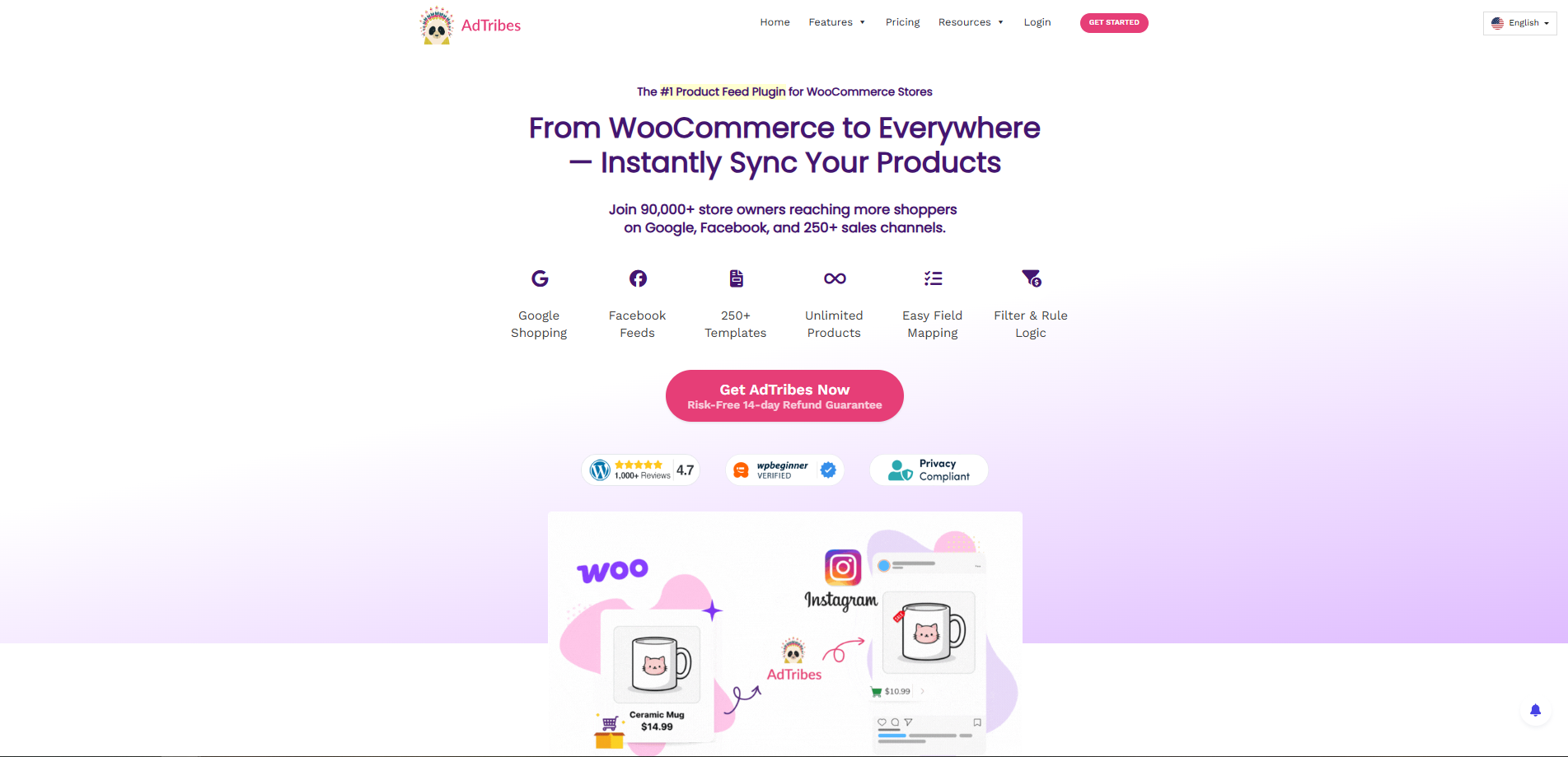
3. AdTribes Product Feed PRO: best for getting your WooCommerce catalog onto Facebook
AdTribes Product Feed PRO is the most widely installed WooCommerce product feed plugin on WordPress.org, with 80,000-plus active installs and a 4.7/5 rating from over 1,000 reviews, and a better alternative to the official Meta for WooCommerce plugin.
Best for: WooCommerce stores that need a reliable, rules-driven product feed to Facebook and Instagram.
Key features & benefits
- Optimized Meta catalog feed with full field mapping, including standard product identifiers (GTIN, MPN, EAN)
- Advanced filtering rules for precise control over which products appear in the feed
- Structured data corrections that help products pass Commerce Manager approval
- Additional channel support (Google Shopping, Pinterest, and more) from the same feed setup.
Areas for improvement & limitations
- Only basic ad tracking, so advanced tracking workflows still benefit from a dedicated tool like Pixel Manager Pro.
- Major updates have occasionally broken existing feed configurations.
- Multilingual support and some advanced filtering features are available only on paid tiers.
Pricing (June 2026): Product Feed Elite paid plans (first-year promotional pricing, 60% off): Growth $79.60/yr (1 site), Plus $143.60/yr (3 sites), Business $159.60/yr (unlimited sites).
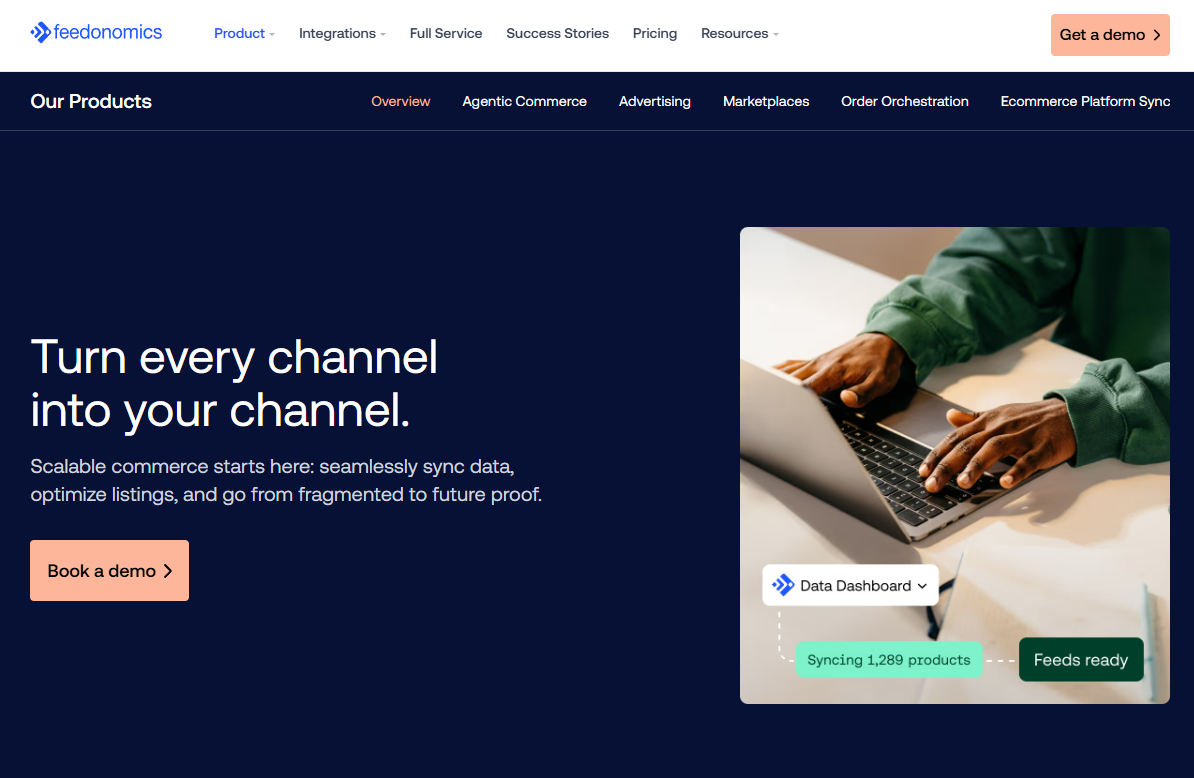
4. Feedonomics Surface: best native option for BigCommerce stores
Feedonomics Surface is the official, native route for BigCommerce merchants who want to sell on Facebook and Instagram.
Best for: BigCommerce merchants who want the official, low-effort path to Facebook and Instagram and are prepared to pay for a managed feed service.
Key features & benefits
- Native integration; no separate third-party app required.
- Four-hour catalog sync with built-in feed optimization for titles, categories, and field mapping.
- A single install enables catalog sync to Google, Meta, Microsoft, Pinterest, and TikTok.
- No-code setup.
Areas for improvement & limitations
- Catalog sync only, Meta Pixel and Conversion API tracking need other solutions: BigCommerce includes native Pixel support, and Meta’s one-click Conversions API covers server-side tracking. Ad campaign management through Meta Ads Manager directly.
Pricing (June 2026): Surface Retail: $29/mo (up to 1K SKUs, 2 channel connections), $49/mo (up to 10K SKUs, 4 connections), $89/mo (up to 30K SKUs, 8 connections), $199/mo (up to 100K SKUs, 20 connections).
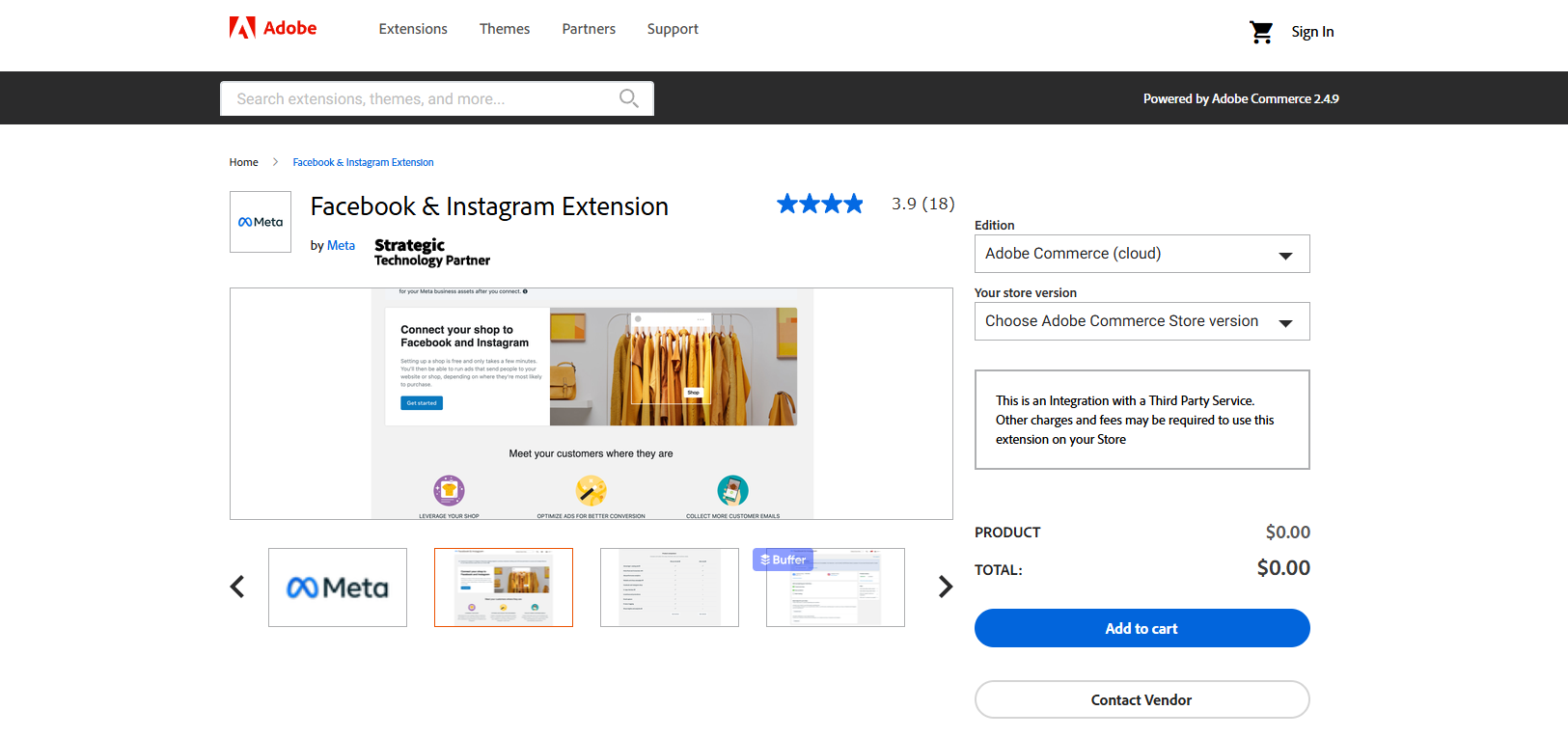
5. Meta for Adobe Commerce: best for Magento and Adobe Commerce stores
Meta’s official extension for Adobe Commerce and Magento 2 covers catalog sync, Meta Pixel, and Conversion API.
Best for: Magento and Adobe Commerce stores that want the official, free integration maintained by Meta itself, and have the technical resources to configure it.
Key features & benefits
- Built and maintained directly by Meta.
- Free to install and use, with no recurring fees.
- Support for all three Magento variants: Open Source, Commerce, and Cloud.
- Catalog sync, Meta Pixel, and Conversion API in one extension.
Areas for improvement & limitations
- Integration with Magento and Adobe Commerce requires developer involvement
Pricing (June 2026): Free.
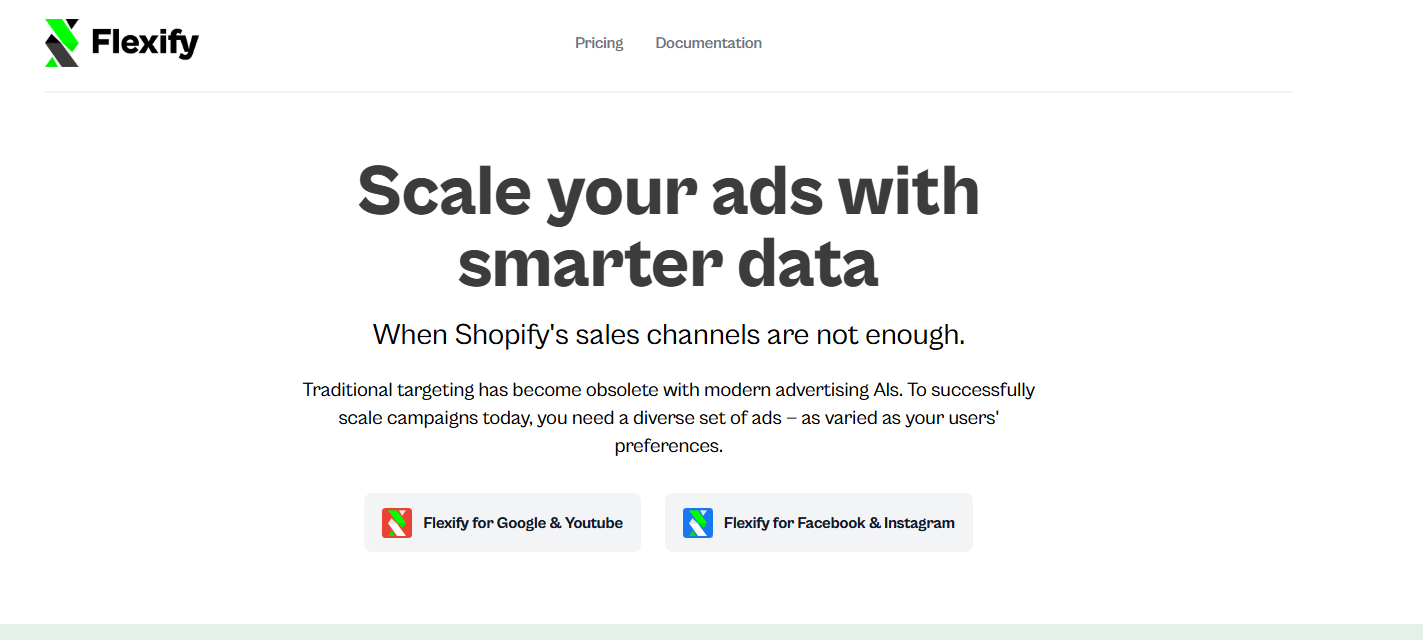
6. Flexify: best for fine-tuning your product feed and ad creative
Flexify is a Shopify app that allows merchants to customize the look of their Meta ad creative to their audience preferences with image overlays, pricing displays, or logos without altering their storefront product photos.
Best for: Shopify sellers running serious Meta ad campaigns who need feed and creative control that the official Meta app doesn’t offer.
Key features & benefits
- Custom product feeds with detailed field mapping and metafield support.
- Image and creative templates for dynamic product ads, including overlay text, logos, and pricing display.
- Tag-to-product-set segmentation for more specific ad audiences.
- Multi-language and multi-currency support for international sellers.
Areas for improvement & limitations
- Advanced features have a steep learning curve, so budget time for initial setup and feed rule configuration.
- Hourly catalog sync and image optimization sold as add-ons.
Pricing (June 2026): Free up to 1,000 products. Premium plans: $29/mo (up to 2K products), $49/mo (up to 5K), $79/mo (up to 9K). Hourly sync add-on: +$20/mo. Image optimization: $4 per 1,000 images.
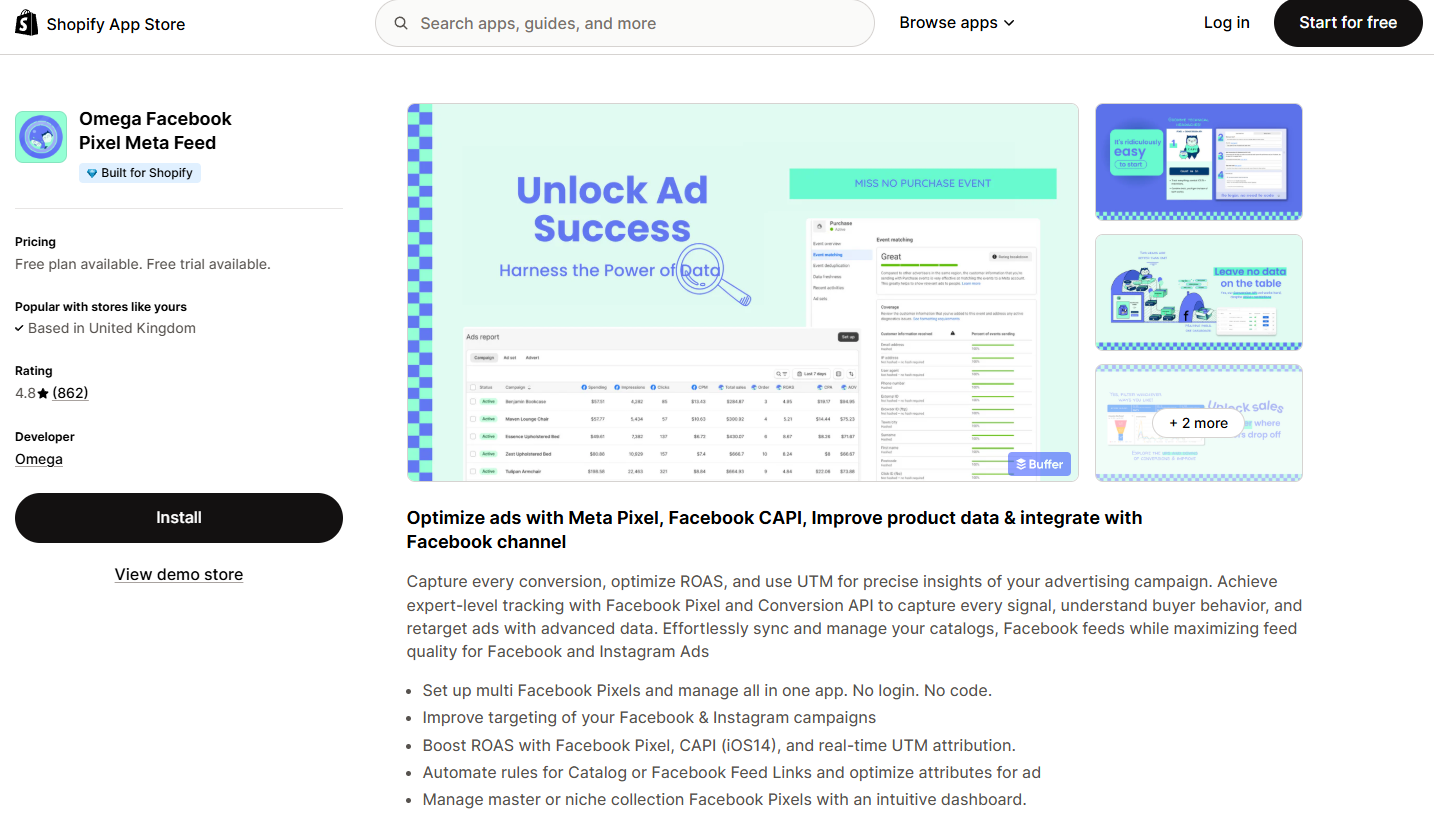
7. Omega Facebook Pixel Meta Feed: best for fixing ad tracking on Shopify
Omega is a Meta ad tracking tool for Shopify that sends conversion data directly from your store’s server to Meta for more reliable reads than via the shopper’s browser, where privacy settings can block it.
It’s an upgrade from CedCommerce’s Pixel and CAPI setup when you need multiple pixels, see conversion discrepancies, or want diagnostics to verify tracking accuracy.
Best for: Shopify advertisers losing conversion data to browser privacy changes and iOS restrictions who need reliable server-side campaign performance tracking.
Key features & benefits
- Support for multiple Meta Pixels from a single install.
- Server-side Conversion API with event deduplication to prevent inflated conversion counts.
- Event match quality scoring to verify how well tracking data connects to Meta accounts.
- UTM attribution for traffic source analysis.
- Built-in ad diagnostics dashboard.
Areas for improvement & limitations
- Catalog and feed sync are included, but not as well developed as ad tracking, so you might need to pair it with a dedicated feed tool for rich feed control.
- Some setup complexity around Conversion API configuration.
Pricing (June 2026): Free plan available. Paid plans: $20.99/mo, $35.99/mo, $45.99/mo. Additional Conversion API connections: +$5.99/mo each.
8. Pixel Manager Pro for WooCommerce: best for accurate ad tracking on WooCommerce
Pixel Manager Pro is the WooCommerce equivalent of Omega: a specialist tracking tool that addresses the duplicate events and missed conversions that WooCommerce stores run into with the official Meta plugin.
Best for: WooCommerce advertisers who want accurate Meta conversion tracking, especially as a dedicated tracking layer.
Key features & benefits
- Accurate Meta Pixel and server-side Conversion API with event deduplication
- Conversion data sent to Google Ads, Google Analytics, and Microsoft Ads from the same install
- 4.9/5 from 397 reviews on WordPress.org, with 50,000-plus active installs
Areas for improvement & limitations
- Tracking only; catalog feed capability was removed in a prior version, so you still need a separate feed tool.
- Full server-side tracking features require the paid Pro tier.
- Advanced tracking configuration, especially Conversion API deduplication, comes with a steep learning curve.
Pricing (June 2026): $149/yr (1 year) or $238.40 for 2 years (saves 20%).
9. Channable: best for large catalogs and multichannel feeds
Channable is a feed management platform built for stores with large, complex catalogs that need fine-grained control over product data sent to Meta and other channels.
Best for: Stores with 1,000-plus SKUs and multichannel sellers who need programmatic, rule-based control over product feeds across Meta and other channels.
Key features & benefits
- If/then rule engine for automating catalog customization at scale.
- Four Meta feed types, including Advantage+ catalog ads.
- AI-assisted product categorization for large or messy catalogs.
- Connections to Google Shopping, Amazon, eBay, and other marketplaces alongside Meta.
- Scalable to several million items.
Areas for improvement & limitations
- Entry-level access starts at €59/mo for 5,000 items; costs increase with catalog size.
- The rule engine may be hard to master, especially for complex feed logic.
Pricing (June 2026): Core Standard €59/mo, Core Plus €79/mo, Core Pro €89/mo at 5,000 items, 2 projects, and 6 channel connections.
10. LitCommerce: best for selling on marketplaces alongside Facebook and Instagram
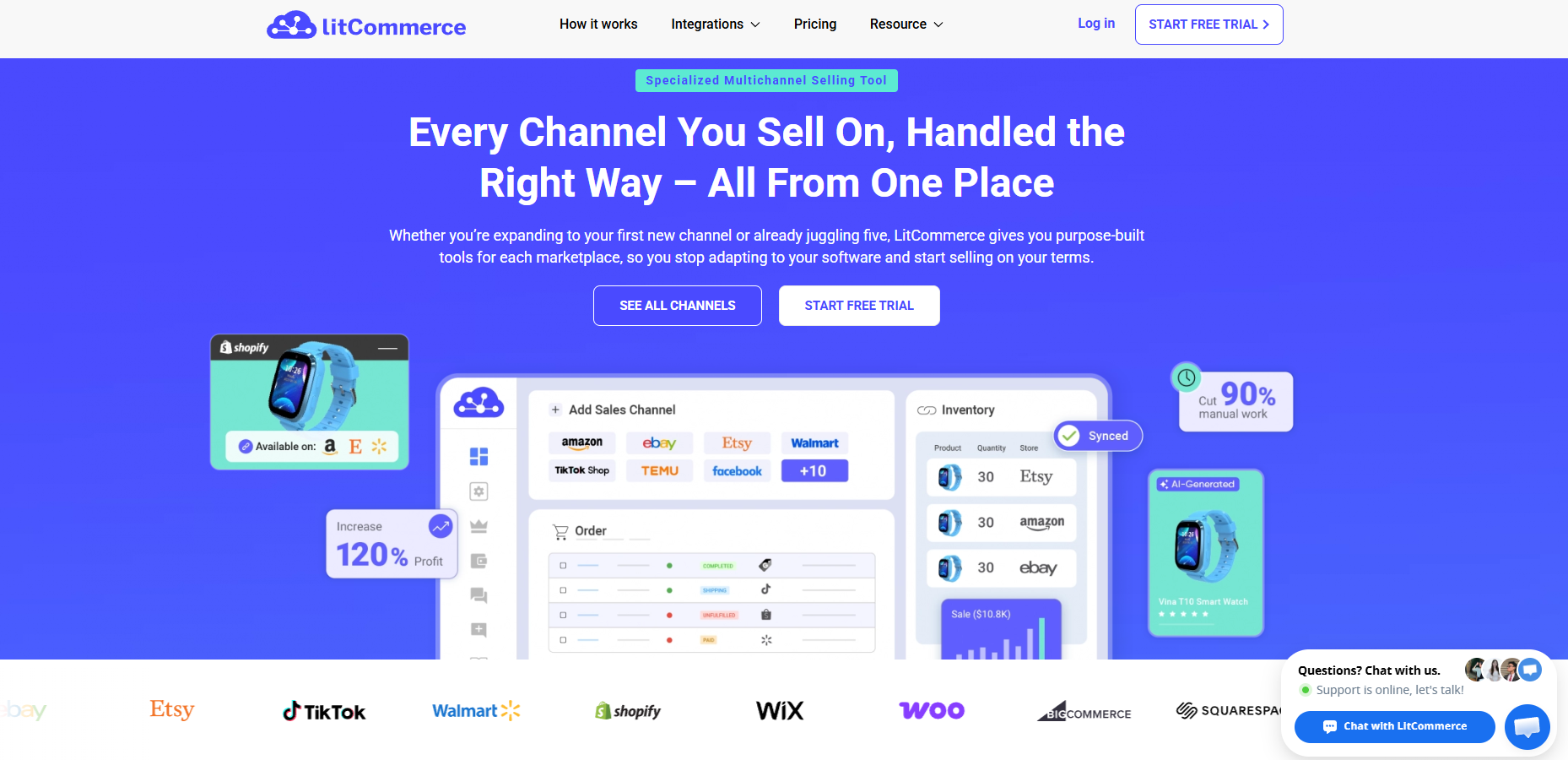
LitCommerce is a multichannel listing tool that syncs one product catalog to Facebook and Instagram alongside Amazon, eBay, Etsy, TikTok Shop, Walmart, and 15+ other channels.
Best for: Sellers with smaller catalogs already reaching customers on Facebook and Instagram who want to expand into Amazon, Etsy, eBay, or other marketplaces without rebuilding their catalog setup from scratch.
Key features & benefits:
- Catalog sync to Meta (Facebook and Instagram) plus 15+ additional channels.
- Central inventory management across all connected channels.
- AI-assisted setup to map products to the right categories per channel.
- Approximately 15-minute sync interval.
Areas for improvement & limitations
- Facebook and Instagram support catalog sync for ads and Shops. Order management is on the marketplace side only, as Meta doesn’t enable order sync through third-party tools.
- Users report occasional quirks during initial configuration, particularly with eBay and Amazon.
Pricing (June 2026): Free plan available; Paid plans from $29/mo (1,000 listings, 3 channels). 20% discount with annual billing.
Choosing the Right Facebook E-commerce App for Your Store
When choosing your Facebook e-commerce apps, answer these questions:
- Do you have an existing store? No? Choose Ecwid. If yes, what’s your e-commerce platform?
- Do you need catalog sync and feed management (Flexify, AdTribes, Feedonomics), ad conversion tracking (Omega, Pixel Manager Pro), or both (CedCommerce)?
- Do you have a large catalog? (Channable)
- Do you want to sell to marketplaces, too? (LitCommerce)
If you’re looking for more insights on how to set up and optimize your e-commerce operation, why not check the Crazy Egg Blog?
Frequently Asked Questions
To finish, let’s answer a few common questions about Meta e-commerce.
Can you do e-commerce on Facebook?
Yes, you can sell on Facebook and Instagram by syncing your product catalog to a Facebook Shop through Commerce Manager, tagging products in posts and Reels, and running ads that link to specific product pages.
However, Meta no longer processes checkout natively on Facebook or Instagram, so shoppers complete their purchase and payment on your website.
Is selling on Facebook and Instagram worth it?
Yes, selling on Facebook and Instagram is worth it — with realistic expectations.
Nearly 40% of social users use Facebook to discover new products (2026), 29% of Instagram users made purchases based on something they saw there (2025), and 62% of US social buyers said their most recent social purchase happened on Facebook (SimplicityDX via E-marketer, June 2022).
What’s the difference between a Facebook Shop and Facebook Marketplace?
A Facebook Shop is your branded storefront, built from your product catalog through Commerce Manager. Shoppers find it on your Facebook Page or through Instagram Shopping.
Facebook Marketplace is a separate space for individual listings and local sales.
What is Facebook Commerce Manager?
Facebook Commerce Manager is Meta’s hub for managing your product catalog, Shops, and selling activity across Facebook and Instagram. When an app imports your store’s products to Meta, they upload to your Facebook catalog in Commerce Manager, and your Facebook e-commerce store and Instagram Shopping draw from it.

