
Why consistent positioning matters more than volume and star ratings for AI-assisted buyer journeys

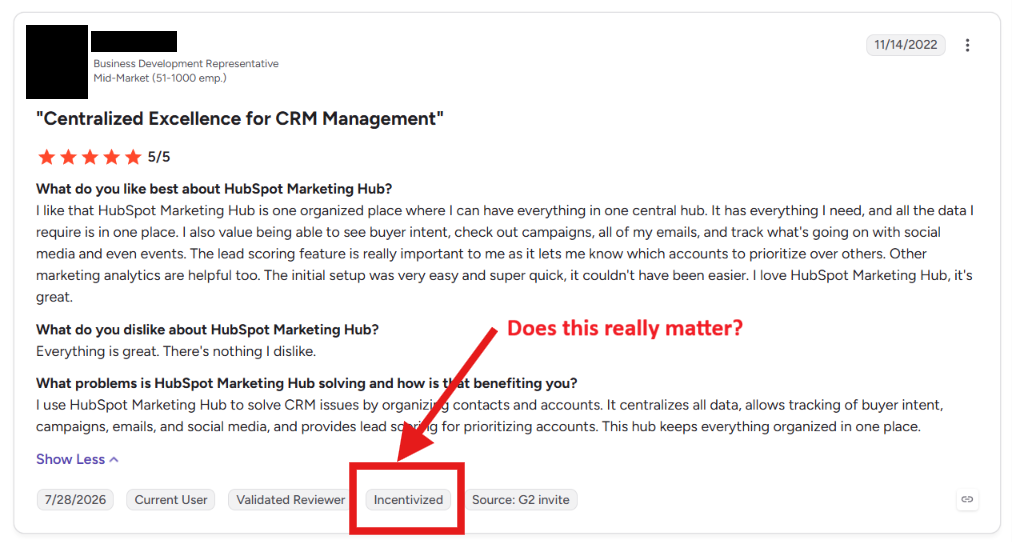
Run an NPS survey, reach out to the happiest users, and offer them an incentive for a glowing recommendation. For years, that formula has been the standard for review generation in SaaS.
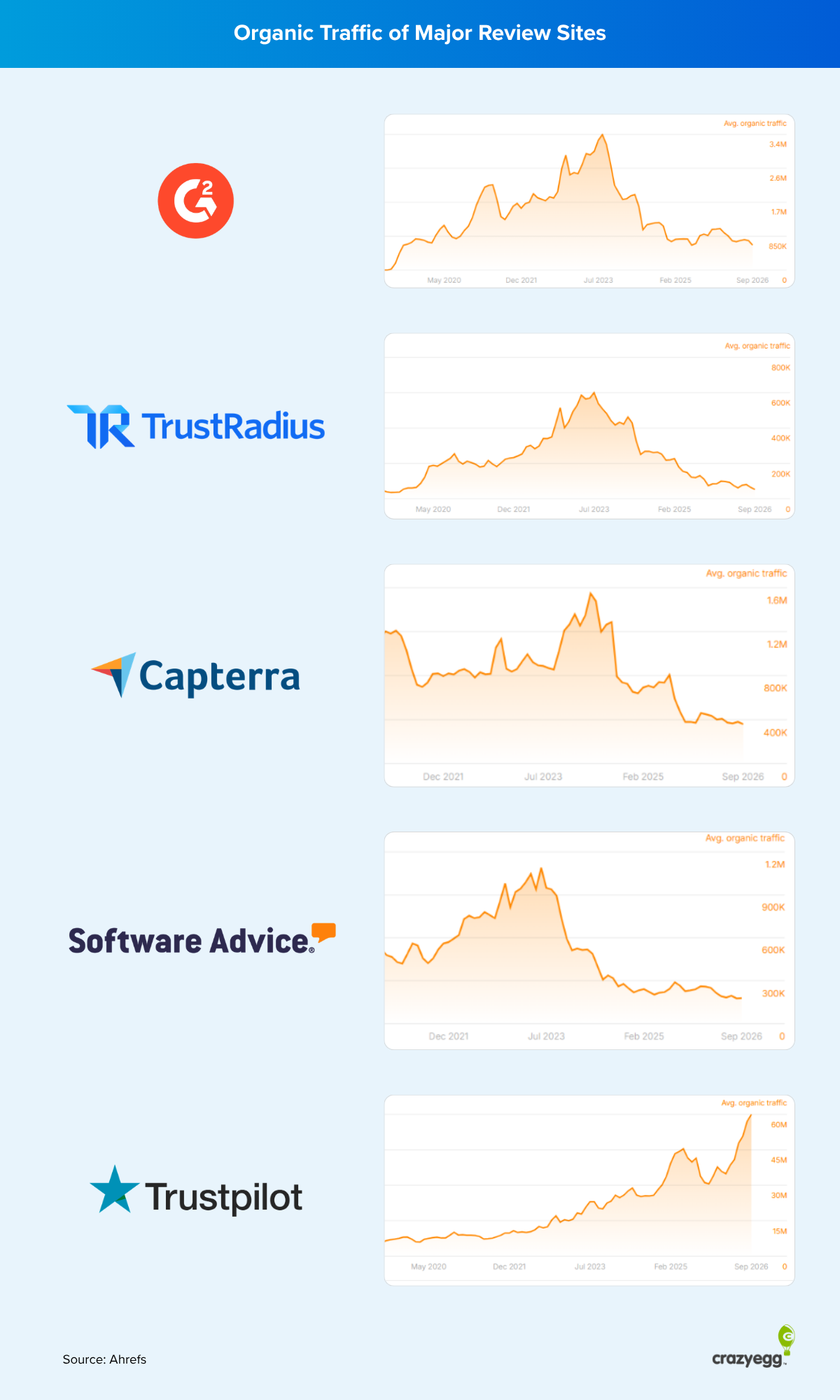
However, traffic to sites like G2 and Capterra has declined significantly. Instead of visiting directly, buyers are using AI tools as an intermediary to consume reviews. They’re asking specific questions, checking platform shortcomings, and triangulating with other sources to verify claims.
What does this mean? In short, chasing lots of positive reviews from happy customers doesn’t cut it any more.
An overhaul of the old solicitation model is needed. Vendors that build detailed and honest bodies of customer evidence will be much more effective at shaping how LLMs understand and respond to questions about their products.
The old method: How B2B SaaS has approached reviews
Having worked in SaaS for over a decade, I’ve seen firsthand how companies, especially startups, solicit reviews.
In most cases, they rely on incentivization campaigns targeted at happy customers. They’ll also send requests immediately after product milestones or paid conversions, both times at which customers are usually satisfied.
Here’s how the process tends to play out:
This method has led many to complain about bias and incentivization. Some have described it as a form of soft gating. One startup founder I spoke to, Toni Hoppen of LandingRabbit, has chosen not to pursue these highly incentivized reviews at all. I suspect his feeling is more pervasive among founders than is widely acknowledged.
“On some platforms, reviews are marketing-generated,” he told me. “On others, the reviews might not represent the whole customer base (just the loudest). … For AI search, reviews are just one piece of data.”
However, despite obvious flaws, the incentivization method has traditionally worked fairly well. One proposed reason is that buyers treat reviews, in large part, like they’re case studies and testimonials. They use them for late-stage evaluation and validation, so their bias isn’t a deal breaker.
According to Axel Lavergne, founder of the review management platform Reviewflowz, people often misunderstand review sites in precisely this way. “G2, Capterra, and any software review platform call themselves review platforms,” he said, “but they’re really testimonial platforms. Always have been.”
He was at pains to point out that this isn’t a bad thing. “Testimonials are ten times more valuable than anonymous ‘objective’ reviews in the B2B space and arguably in many other industries,” he said, describing the relevance of relatable, detail-heavy testimonials during software evaluation.
However, bring LLMs into the mix, and other major shortcomings of the “NPS promoter strategy” become more serious. To understand why, we need to consider two factors: where reviews sit in AI-based buyer journeys and how users interact with them using AI tools.
Where do reviews sit in the B2B buyer journey?
Much and more has been written about the B2B buyer journey. One of the issues with popular models is that they assume a linearity that multiple studies have shown doesn’t exist. A study by Dreamdata, for example, found the average journey involves 10 stakeholders and spans 88 touchpoints across 4 channels. In addition, 82% of buyers enter the market with a preferred product in mind.
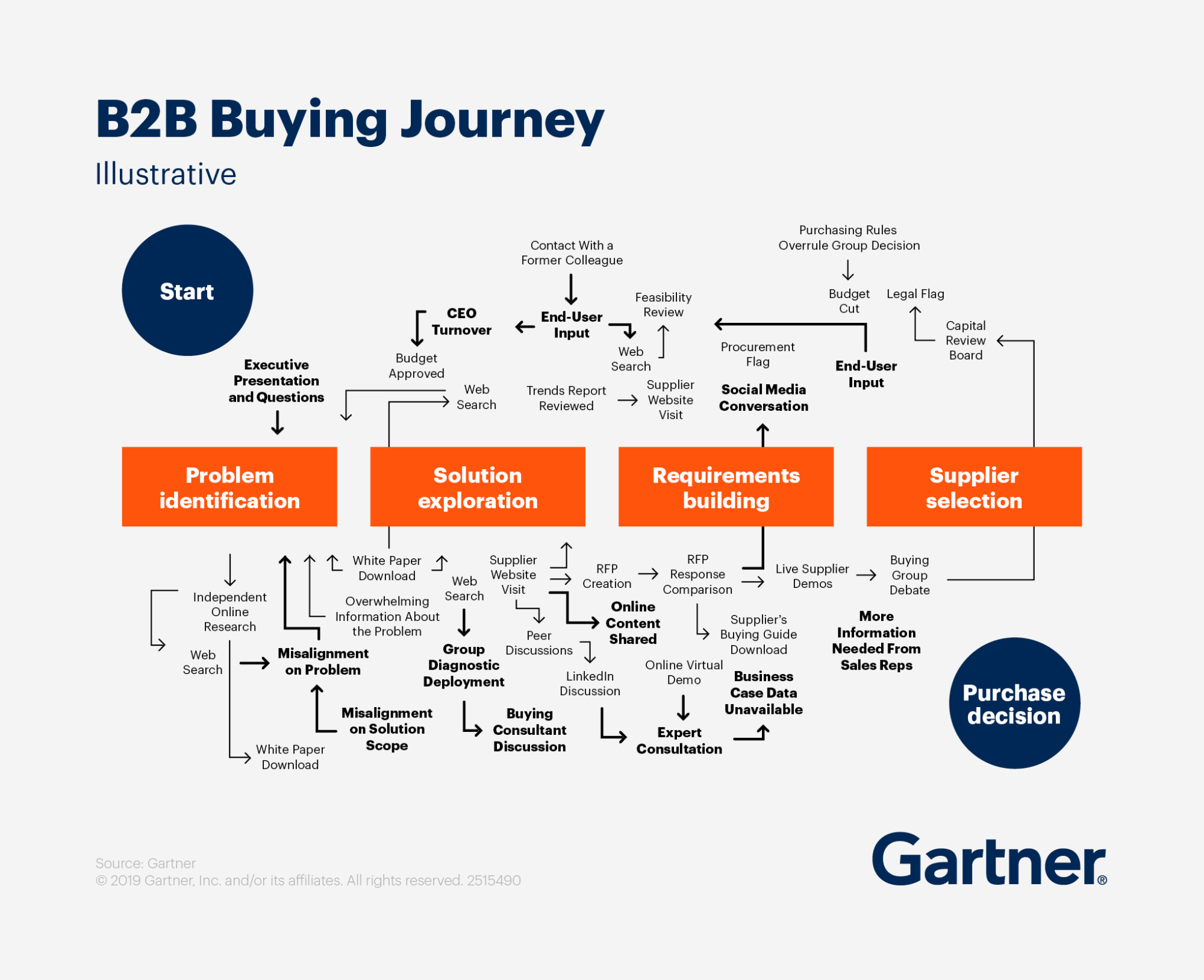
For this reason, I like Gartner’s buying-jobs model, which understands the buyer journey as a set of tasks in need of completion but not in any pre-set order. It identifies these tasks as problem identification, solution exploration, requirements building, supplier selection, validation, and consensus creation.
This model can also help illuminate how reviews act as later-stage evaluation and validation collateral for an existing shortlist.
Here are the three stages where reviews fit into the model:
- Solution exploration, focused on the question, “What’s out there to solve our problem?” This is the longlist stage where the aggregate component of review platforms comes in: the rankings, awards, and category winners. “You go to G2 to get a read on the market,” Axel told me. (Sources: G2, TrustRadius)
- Supplier selection, focused on the question, “Does this do what we want it to do?” This is the stage at which buyers put together and refine their shortlists. In the later stages, typically after a full review of features and pricing using vendor websites, buyers use segment-specific qualitative reviews to provide evidence that their chosen vendors will work for them. (Sources: Reddit, G2, 6sense, TrustRadius, Consesus)
- Validation, focused on the question, “We think we know the right answer, but we need to be sure.” Reviews provide final confirmation that a vendor or set of vendors are the right choices. This is also where defensive decision-making comes in, and reviews are important for limiting career risk should a decision later be questioned (Sources: G2, Reddit, Forrester, UserEvidence)
Data from 2025 found that buyers look at an average of three to four reviews per session. And a degree of direct reading is likely to continue. “Reading the 10 most recent negative reviews on G2 about any software solution will tell you more than any complex prompt scraping hundreds of websites,” Axel told me.
However, LLMs are ushering in an era of deeper triangulation. As buyers supplement direct interaction with review sites with AI-augmented summaries, gaps in coverage become much more of an issue.
LLMs essentially allow buyers to synthesize large volumes of a vendor’s reviews in seconds and, crucially, compare them against the reviews of other vendors. This makes the need for detail, comprehensiveness, and wide coverage across all relevant segments, verticals, and use cases a much greater priority.
The impact of AI on traffic to B2B review sites
Large portions of the buyer journey have shifted into AI interfaces. One of the most cited surveys on the topic by Forrester (18,000 buyers) found that 94% of buyers use AI in some form.
Research by Semrush also shows considerable use of AI at all stages: 72% in early research, 62% for comparison, 48% for shortlist fine-tuning, and 45% to support the final decision. G2 itself ranks AI chatbots as the number one source influencing shortlists.
Review sites have undergone a marked decline in traffic. Ahrefs organic traffic data of four of the main review sites shows the trend clearly. Trustpilot is one notable outlier for which traffic has increased, likely due to its prevalence as a citation source.
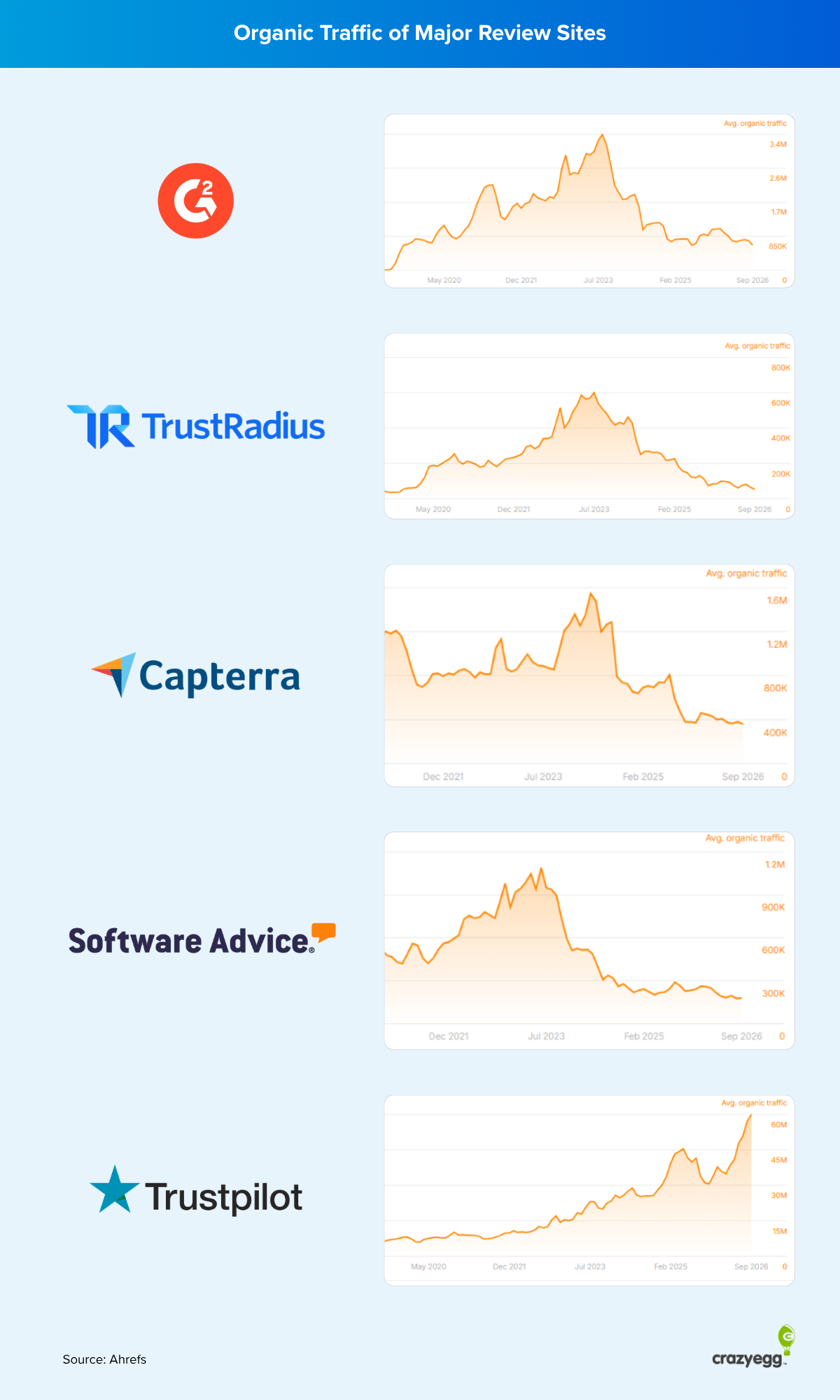
However, there is also a definite trend of increasing citations in AI-generated answers for all sites. G2 is the top-cited source for prompts seeking proof and evidence for B2B software reviews according to research by Omniscient.
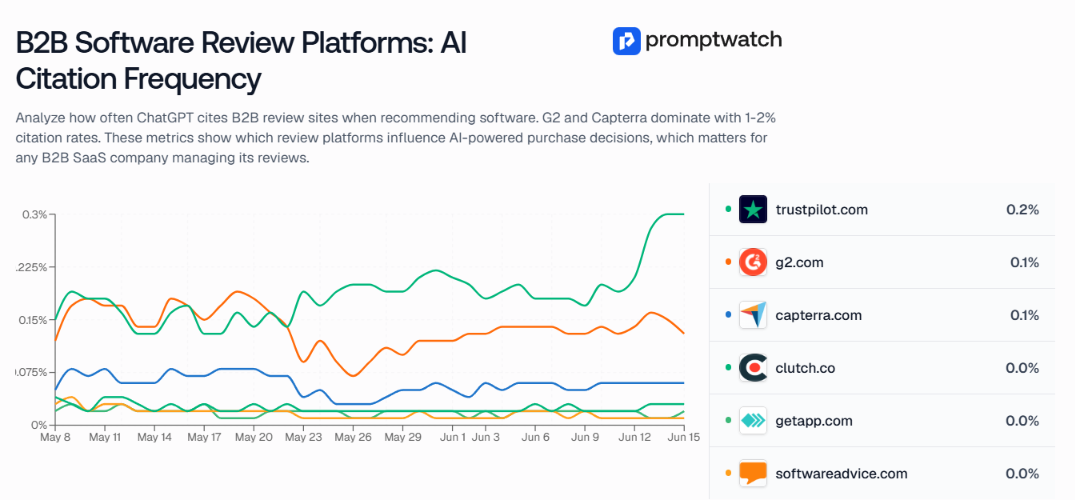
With its recent acquisitions of Capterra, Software Advice, and GetApp, G2 is set to hold the second largest share of citations for bottom-of-funnel software prompts out of all sites (above YouTube and LinkedIn). Data from PromptWatch also demonstrates the prevalence of review platforms in B2B software queries.
5 ways AI has changed how users interact with reviews
Traffic matters less than it used to. But buyers are consulting review sites. Multiple studies show that they’re among the most cited sources by LLMs.
Driving up citations and influencing responses in a way that’s favorable to your brand first requires an understanding of how users are behaving in the AI interface.
Here’s what we know about LLMs and prompting behavior:
- Users are asking highly specific questions: Users are asking LLMs detailed and context-dependent questions, including those about B2B software. Semrush analyzed more than 1 billion lines of US clickstream data containing ChatGPT prompts. Between 65% and 85% of prompts could not be matched to traditional keyword queries. Semrush attributes this to complex, contextual questions. (Sources: Semrush, G2)
- LLMs aggregate across multiple data sources: Answers to prompts cite multiple domains, and this increases with prompts of greater complexity. Source types can also be disparate: pricing page information and Reddit reviews often sit alongside each other. (Source: Semrush, Profound)
- LLMs can deal with much larger volumes of data: Frontier models have enormous context windows and essentially treat review sites as a massive database of real-world case studies, extracting what the buyer wants. Models are constantly getting better at browsing, gathering information, and synthesizing it. (Source: BenchML)
- LLMs make niche and use-case-specific information easier to find: Because of query fan-out, in which a prompt is broken down into subtopics, AI models can return “hyper-relevant content” that matches user questions. There is also evidence that “validating specific use cases” is one of the primary reasons buyers use AI tools. (Sources: News from Google, G2)
- LLMs default to the consensus: LLMs have been described as “consensus machines.” They use vast amounts of training data in conjunction with grounding searches to output the most likely answer to a prompt based on the body of digitized information available. (Source: Skeptical Science)
This behavior is a direct challenge to the old model of review incentivization. Before AI, reading reviews was a time-intensive process. Even with filters, there was a cap on how many a buyer could feasibly consider, and triangulation was always an incomplete process.
LLMs have largely resolved these issues. Triangulation at scale is now possible, and buyers can prompt LLMs with very specific questions to validate use cases, check for issues, and confirm the kinds of outcomes professionals or companies in similar roles have achieved.
Because of this, using reviews to boost and maintain LLM presence in a meaningful way requires two things of SaaS companies.
How to modernize your review generation model for AI-assisted research
To understand how vendors should adapt their review generation strategies to a world of LLM-based aggregation and synthesis, I spoke to three experts actively working in the space. I asked them about the current state of reviews, the impact of AI search, and which practical steps they recommend.
1. Ask for reviews from all users, not just NPS promoters
Data shows that reviews are treated like testimonials for later-stage validation. However, sourcing them exclusively from your happiest customers creates a risk of what Russell Rothstein describes as an overly one-sided picture: “Soliciting reviews only from “promoters” with high NPS scores creates a sanitized, unrealistic picture of the software, which ultimately frustrates buyers.”
Axel Lavergne agrees with this assessment, describing the practice as “lazy and ineffective.” Instead, he advocates for an approach in which all respondents to an NPS survey are encouraged to leave feedback.
Importantly, soliciting broadly is unlikely to cause a glut of negative reviews, something many vendors fear. “In the B2B space, it is extremely rare to go and publicly shame a company,” Axel told me. “First of all, because it makes employees look bad to potential recruiters, but also because for a B2B relationship to go south, it very generally takes two parties.”
Instead, it provides exactly what LLMs are looking for: a cross section of all your use cases and segments and a narrative that is congruent with actual usage.
2. Encourage details specific to a range of use cases and verticals
Buyers with an existing shortlist are interested in product proof for particular use cases and verticals. This means you should encourage as much detail as possible when pushing for reviews. You can also monitor segment and vertical coverage and tailor your outreach process to fill in any gaps.
Branca Ballot has found this corresponds with both her own experience and that of users: “I take a very quick glance at the overall score, but the important thing is to see specific things people say about a platform.”
It is good practice to encourage coverage of negatives, too. Vendors dislike the idea of a review that cites problems with their platform. But this is because they’re often looking at B2B reviews through a B2C lens.
Buyers actively seek out platform shortcomings. It’s an important part of the evaluation process, and the best possible way to present issues is in an otherwise positive review. “I personally read bad reviews only, because that tells me what the problems to expect are, and I can then decide if I can live with those problems, or not,” Axel told me.
Russell also advocates for a balanced approach: “We always ask the reviewer to provide room for improvement, and you’ll see some very critical points in PeerSpot reviews, even from customers who give it a high ranking. We believe that transparency, shining a light and being fully transparent, is the best way to build trust with software buyers.”
3. Ensure your owned assets match recent reviews
LLMs can be understood as consensus engines. Answers are drawn from a mix of training materials and grounding searches, in which pre-existing information is augmented or cross-validated against live content.
This makes it important to ensure the consistency of your core narrative across as many sources as possible. You can’t do this for all materials published across the web, of course, but you do control your own assets, and their impact on AI answers is significant.
All of the following should broadly match the details in your recent review content:
- Case studies
- Pricing pages
- Competitor comparisons
- Product documentation
- Security/compliance pages
- Implementation guides
- ROI calculators
- Demos and trials
LLMs demonstrate a recency bias, giving disproportionate weight to “fresher” reviews, so don’t worry if you’ve updated features or positioning recently. If you’re seeing a mismatch, the issue is likely in your own content. Reviews, on aggregate, represent an up-to-date overview of the features users have access to.
4. Diversify beyond G2
When I spoke to Russell, he told me something interesting about PeerSpot: “Cloud marketplaces are becoming a dominant channel for buying business software; they now account for over $1 trillion in annual sales. Since PeerSpot is the exclusive provider of first-party reviews for Google Cloud Marketplace and AWS Marketplace, our reviews are influencing more and more buyers as these marketplaces grow.”
I’ve worked for dozens of large SaaS companies, and my overwhelming experience has been of a disproportionate emphasis on soliciting reviews for G2. However, the influence of other platforms can be significant. It’s just not always immediately visible.
Keep in mind that Trustpilot outranks G2 as a citation source according to Promptwatch, and the submission process can be much faster. Other platforms, like PeerSpot and Gartner Peer Insights, are recognized by LLMs as segment authorities, such as for enterprise-level solutions.
If you’re running an established process, expanding that out to other platforms is usually straightforward. With G2’s recent acquisition, it’s entirely conceivable that buyers will increasingly seek out differentiated review sources.
Branca suggests a sequential approach before moving further afield. “My advice is don’t spread yourself too thin,” she said. “Get one review site going well, and then you expand. Many companies try to do all at the same time, and it doesn’t work.”
5. Don’t overlook review volume entirely
While volume shouldn’t be the top priority for providers, it does matter at the longlisting stage. When a potential buyer enters the market, they will use LLM-based research to understand what’s available, and aggregate data is used here. “You go to G2 to get a read on the market,” says Axel.
Software brands tend to overestimate their G2 badges. They’re viewed as pay-to-play by many buyers. And some A/B tests show that including badges on SaaS pricing pages can actually reduce conversions.
Nonetheless, LLMs do cite rankings based on numbers of reviews, particularly when asked questions about the makeup of a particular category.
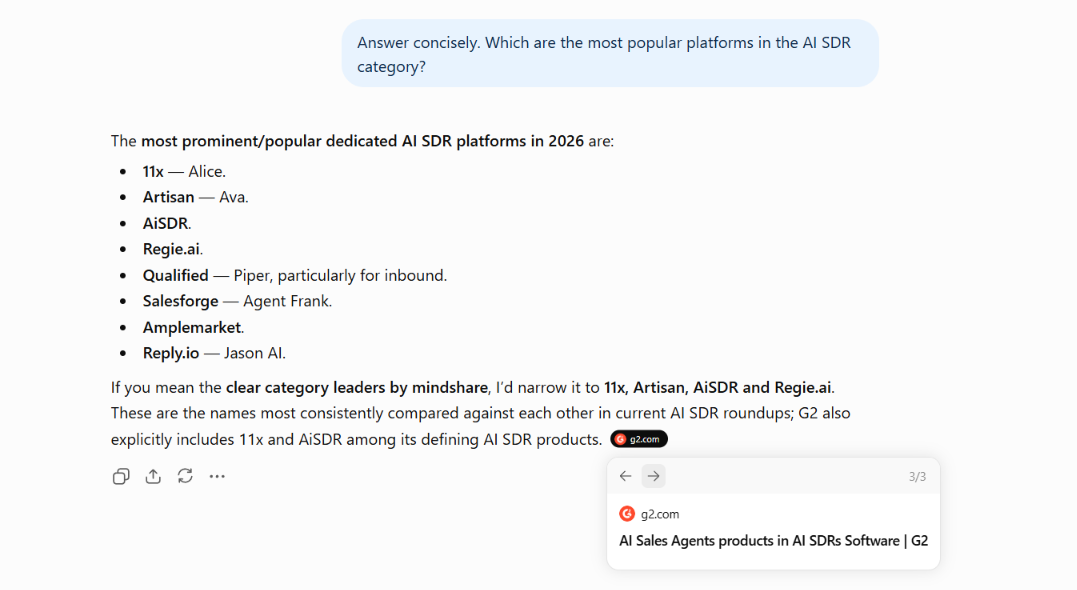
So while reviews mainly act as proof for later-stage evaluation, there is value in quantity. Also keep in mind that including customers outside of NPS promoters will help you increase volume.
Non-direct compensation avoids spiraling incentivization costs. Branca recommends such an approach: “I’ve been very successful running time-based campaigns and draws, such as the chance to win a laptop or $1000.”
In scenarios where compensation is offered, it’s a good idea to emphasize to a user that they’re being rewarded for their time, not a five-star rating.
Your goal should be to build a consistent narrative that can sustain interrogation by AI
Your goal should be to facilitate a consistent, detailed, and honest narrative about your product across the web.
Reviews offer an unusual opportunity to do this. They are third-party sources, heavily favored by LLMs, that you have a degree of control over.
Keep the following points in mind when soliciting reviews in the era of AI search:
- Drive reviews across all target segments, use cases, and verticals.
- Encourage a high level of detail from customers and prioritize review platforms that enforce depth.
- Ask customers to be honest about shortcomings (they’re not dealbreakers for buyers).
- Post across a multitude of review platforms, not just G2, for maximum coverage.
- Accept that quantitative rankings (such as from G2) are useful for getting you into LLM-generated longlists.
Finally, ensure that your own assets present a coherent narrative that isn’t at odds with the information presented in reviews. This applies equally to your positioning, feature descriptions, and ideal use cases and ICPs.
LLMs are consensus engines, and there are many third-party sources that you have zero influence over. That’s why it’s so important to prioritize those where your strategy does make a difference.
